
Australia’s aged care sector is facing a critical shortage of services and qualified health professionals. With Australia’s ageing population growing faster than ever, this shortage is set to intensify – posing serious risks to the quality and accessibility of care.
In response, a new federal Aged Care Act will take effect in November 2025, introducing major reforms aimed at helping older Australians maintain independence, with a stronger focus on in-home care and enhanced primary healthcare services. However, policymakers do not currently have access to robust evidence of the effectiveness of past and current in-home care policies, making it impossible to reliably forecast the impact of future policies.
To address this gap, Professor Nadine Andrew is set to lead a $1.5 million research project funded by the National Health and Medical Research Council (NHMRC) through its Ideas Grant scheme. In partnership with Bayside Health Peninsula and Monash University under the National Centre for Healthy Ageing, the four-year study will develop a comprehensive population dataset to support rapid, reliable evaluation of past and present aged care policy and simulation of the effectiveness of future policies.
“Essentially, our aim is to provide evidence on the effectiveness of current and future federally funded policies related to ageing. We’re particularly focused on services delivered through general practitioners, such as chronic disease management plans and medication management plans, as well as in-home care models like home care supports,” explains Professor Andrew.
The project will be rolled out in three phases. Phase One will focus on developing a comprehensive population dataset for the entire Frankston-Mornington Peninsula region. This dataset will establish linkages between Electronic Health Record (EHR) data and relevant state, Commonwealth, and administrative datasets, enabling a more integrated and accurate view of population health.
“Importantly, the dataset will also be shaped by consumer lived experience,” adds Professor Andrew. “We’ll engage with consumers to understand factors that help them live well in the community. Important factors such as social supports, which are not readily available in the linked EHR and government datasets, will be generated through the application of artificial intelligence to clinical notes.”
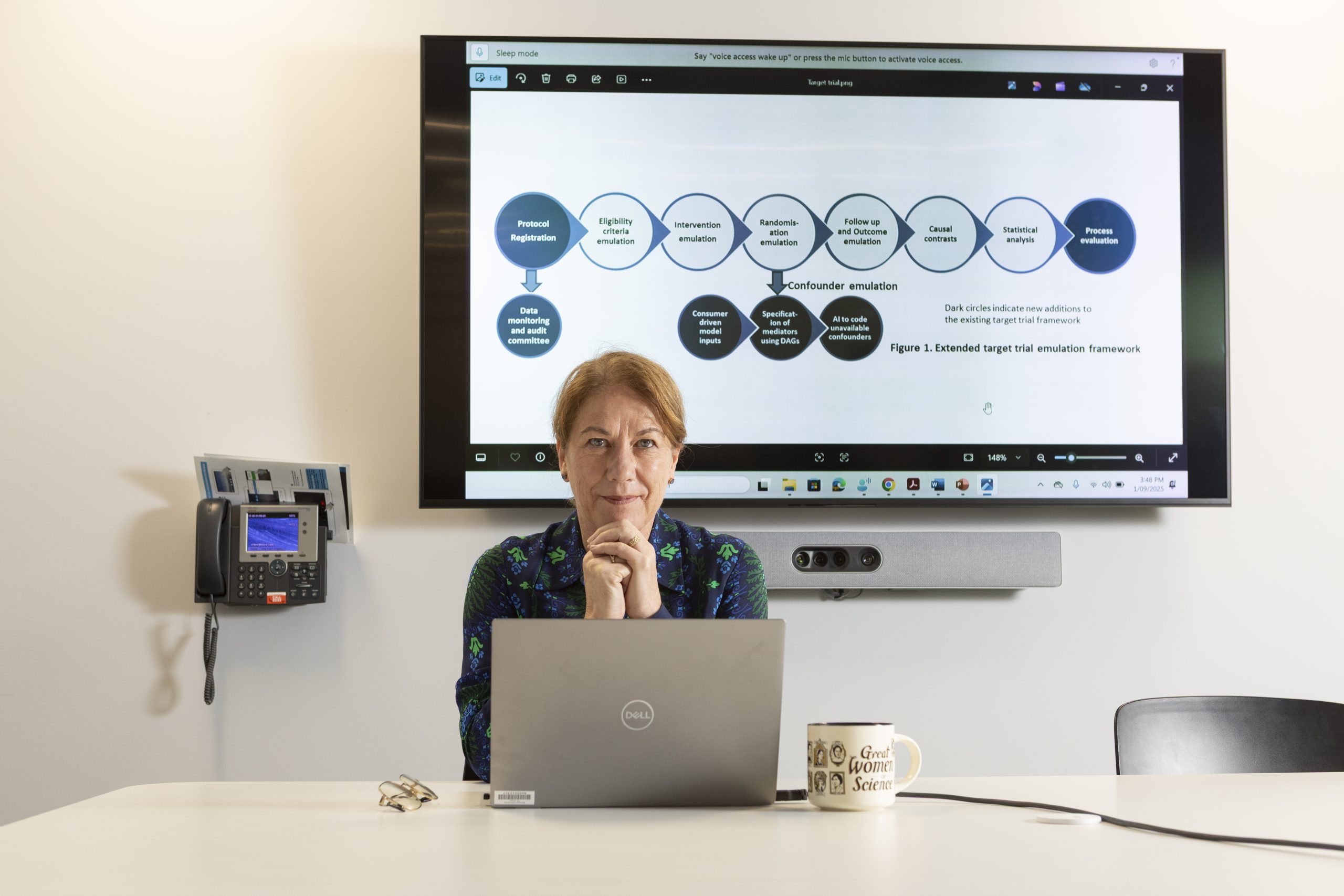
Phase Two will focus on developing a new framework for the emulation of target trials involving complex interventions. This framework will then be applied to the linked population dataset.
“Target trial emulation is a relatively new and cutting-edge approach to data analysis,” explains Professor Andrew. “It allows us to use all of our data within a structured framework to replicate the conditions of a clinical trial as closely as possible. This method has been shown to produce more robust and reliable evidence compared to many traditional approaches typically applied to observational data.”
As part of this process, Professor Andrew and her team will also develop a suite of tools and frameworks for application to observational data, similar to those used to uphold the level of rigour typically required in clinical trials.
Phase Three will culminate in the creation of a regularly updated, linked data asset. This resource will be used to evaluate emerging policies and simulate future Commonwealth-funded initiatives aimed at helping people remain living independently in the community.
“Our ultimate goal is to build a simulation platform that government agencies can use to test ideas and policies in a virtual environment,” says Professor Andrew. “This would allow for evidence-informed decision making before real-world implementation.”
“They’d be able to simulate a new policy, or a change to an existing one, using the dataset and see what impact it might have on the number of people transitioning to aged care as a result.”
Creating this platform will not only influence practice and policy, but it will also help align them with consumer preferences. “We know that most older people want to stay in their own homes for as long as possible, with the right supports in place, and we’re working to make that achievable,” concludes Professor Andrew.
By understanding how to help people stay healthier for longer and remain living in the community, this project will advance multiple fields, including target trial emulation, data linkage, biostatistics, and policy evaluation, while delivering critical knowledge and real-world evidence to inform policy development for healthy ageing.