
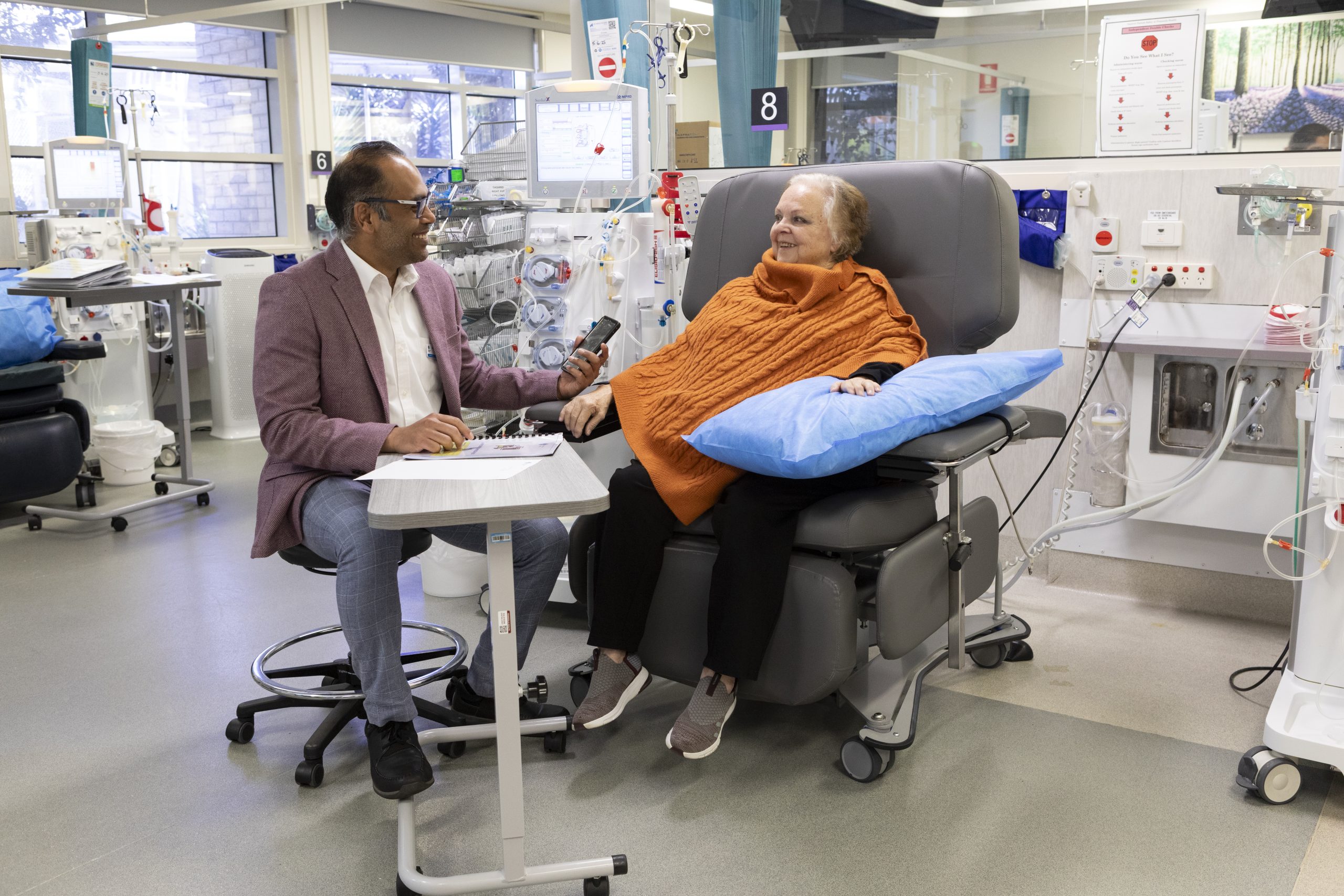
The attitudes, beliefs, and decision-making process of elderly patients in their management of end stage renal disease (ESRD) have been examined in a new study by Dr Vinod Venkataraman, a nephrologist at Bayside Health Peninsula Care Group.
The interviews were conducted with 12 patients receiving dialysis and eight patients receiving conservative kidney management, who were over 65 years of age and diagnosed with ESRD in the last five years. All had an English-speaking background.
Dr Venkataraman’s study found that emotions on confronting death are varied and they have a significant but subtle influence on decision-making for patients. Better understanding these emotions is considered essential for clinicians to deliver patient centred care. Decision-making for elderly patients with ESRD about treatment options is a complex process.
“We identified a knowledge gap in the literature about the influence of emotions on confronting death,” explains Dr Venkataraman.
“Our research objective was to explore the attitudes, beliefs, and decision-making process of elderly patients in their management of ESRD.”
“We focused on two main research questions: How does death anxiety differ in elderly patients with ESRD between the dialysis treatment and the conservative kidney management groups? And what is the role of death anxiety in the decision-making process?” adds Dr Venkataraman.
The research methodology chosen was interpretive phenomenology, using semistructured interviews based on seven pre-determined questions.
The interviews identified six themes:
- ‘Illusion of choice’: The concept of decision-making is based on choice, and that itself can be dubious
- ‘Myriads of emotions on facing the inevitable’: Participants faced various emotions on approaching death, both positive and negative. Death anxiety is not the only emotion faced by people in this situation
- ‘Death denial and acceptance’: The thoughts involved in processing the news of death are variable too. Death anxiety, a manifestation of an inability to process the news of death, was fairly distributed in both the dialysis and conservative kidney management participants
- ‘Coping with news of death’: Multiple strategies were employed to overcome these emotions when confronting death. Some were self-reliant and others from external support
- ‘Process of decision-making’: Participants were influenced subtly by their emotions in various ways
- ‘Receptivity to education and information on facing news of death’: The clinicians’ knowledge and education were not able to help participants when these emotions surrounded them
Dr Venkataraman found that a lack of insight into these emotions can lead to frustration of clinicians and patients in the decision-making process.
“Further quantitative research into death anxiety needs to be conducted to appreciate its full impact in the Australian environment,” explains Dr Venkataraman.
“The emotional preparedness of clinicians also needs to be studied for establishing the best possible patient-centred care.”
ESRD is the last stage among the five stages of chronic kidney disease. Patients experience many symptoms due to uremic toxin build-up – such as tiredness, fatigue, loss of appetite, and weight loss.
The symptoms can be due to electrolyte disturbances like high potassium, high phosphate, and low bicarbonate levels. They can also be due to fluid buildup and associated shortness of breath. If these complications are not treated in time and adequately, the patient’s life can be compromised.
The treatment options for ESRD consist of transplantation, dialysis and conservative kidney management. Transplantation involves a major surgical procedure and significant suppression of immunity to implant another’s kidney into the patient’s body, to remove the toxins that are not cleared by the patient’s own kidneys.
Dialysis involves an invasive and intense treatment procedure for the patient, where an external machine clears the toxins and fluid built up in the patient’s body. Conservative kidney management is a gentler treatment option, where symptoms and complications are managed by medicines and non-invasive measures only. This disease and its treatment have a big impact on our population.
“Clinicians need to be educated on the various emotions patients could face, which will pave the way for better shared decision-making,” explains Dr Venkataraman.
“By knowing and understanding these emotions, clinicians can connect, empathise, address, support and acknowledge them in their ongoing interactions with patients with ESRD.”